Thinking about Thinking
On the egalitarian, adventurous, and rebellious - democratic - spirit of thinking.

There are no dangerous thoughts; thinking itself is dangerous
Hannah Arendt (1971)
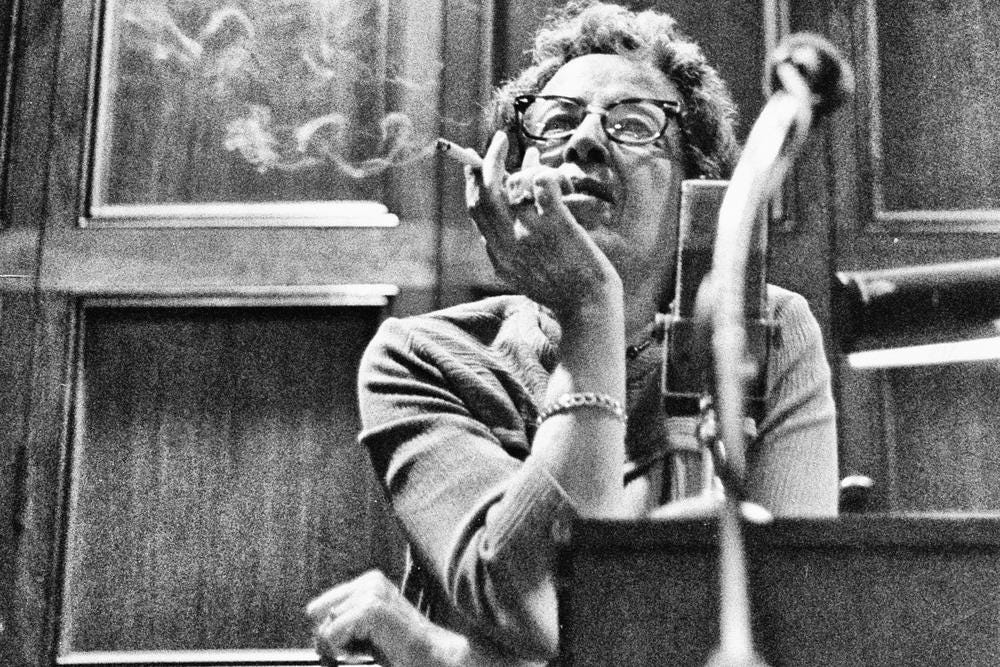
Hannah Arendt (1906-1975); Deutsches Historisches Museum/Art Resource, New York, Hannah
Arendt Bluecher Literary Trust
This experimental essay plumbs the depths of democracy’s core ideals and makes a case, in our troubled and turbulent times, for radically rethinking its taken-for-granted precepts and bedrock prejudices. My goal is to go beyond the current academic fashion of arguing about the ‘resilience’ of ‘liberal democracy’ versus a ‘crisis of democracy’ that millions of people nowadays rather obviously can see for themselves, and are living through, on a daily basis. The purpose is rather to take a step back from the obvious and immediate, to make a case for thinking about democracy by showing that previous accounts of thinking have often misunderstood its meaning and democratic significance, and to do all this by capturing in thought and ‘mimicking’ in writing the egalitarian, adventurous, and rebellious - democratic - spirit of thinking.
The starting point of this exercise in thinking about democracy is a rather discouraging counter-reality: what is often called the problem of thoughtlessness. Complaints about unthinking behaviour have long been a hallmark of work done by scholars in the human sciences. These protests against thoughtlessness have never been politically innocent. Their sympathy for democracy has been restrained. Especially in modern times, thinkers and writers who have complained about thoughtlessness target popular ignorance. Their focus is not bad manners or the inconsiderate carelessness of humans – one common meaning of the English word thoughtless – but something far more serious. For these critics, the widespread failure of people to think, or their inability to think well about the world in which they are living, is politically harmful. Even when it is treated as the butt of jokes, as in the quip that elections are occasions when voters finally display their cluelessness, thoughtlessness is reckoned to be no laughing matter. Thoughtlessness is seen as a curse, as a condition much worse than the lack of mental focus, absentmindedness, or dazed and confused forgetfulness. The failure to think - to indulge to excess what is variously called irrationality, stupidity, birdbrained behaviour, feather headedness, wilful ignorance or worse – is accused of complicity with serious misfortunes, disorders and crimes that make a mockery of the spirit and substance of popular self-government.
For more than a few of these thinkers and writers, we are going to see, chronic thoughtlessness underscores the absurdity of democracy. It shows that the whole image of humans as ‘rational animals’ is false, that in practice humans have forfeited their right to be measured against the standards of reason (ratio) or that finally they have revealed themselves as dangerous creatures of passion. ‘The masses have never thirsted after truth’, runs one version (by Gustave Le Bon) of an old line of analysis. ‘They turn aside from evidence that is not to their taste, preferring to deify error, if error seduce them. Whoever can supply them with illusions is easily their master; whoever attempts to destroy their illusions is always their victim.’[1] Such attacks on the gullibility of the masses - as if ruling groups themselves suffered no such illusions - were reinforced by complaints about the blind envy of ‘the people’. Especially during the first decades of the 20th century, writer after writer slammed the whole idea of democracy as a bogus arrangement for stirring up stupidity, enmity and jealousy. Democracy is ‘a device for releasing…hatred born of envy, and for giving it the force and dignity of law’, wrote the Baltimore wit H. L. Mencken. Democracy idolises the ‘plain people’ whose ‘thinking is done on the level of a few primitive appetites and emotions’. That’s why democracies ‘pass over statesman of genuine imagination and sound ability in favour of colourless mediocrities’, and why there are times when democracies degenerate into ‘government by orgy, almost by orgasm’.[2] The British conservative monarchist and eugenics champion Anthony Ludovici agreed. Democracy ‘is merely a grandiose device for appeasing envy.’ Democracy stirs up muddle. It panders to the jealous stupidity of the underclasses, whose ‘talk is the babble of babes, their vocabulary the means of expression for creatures whose feelings and thoughts are no more complicated than those of primitive savages. Not only are they incapable of understanding complex states of feeling or complex thoughts when they hear them accurately and carefully expressed, but they are also utterly unable to give expression to at least three-quarters of their own thoughts and emotions.’ [3]
Warnings about the dangers of unthinking behaviour are nowadays enjoying a resurgent popularity. There are critics who are saying that thoughtlessness gives the lie to the high ideals of democracy, and that since citizens are entitled to ‘competent government’, and since rule by the ‘knowledgeable’ is the precondition of effective and efficient government, the ignorance and irrationality promoted by democracy must be replaced by experiments in ‘epistocracy’. [4] A parallel objection to thoughtlessness has surfaced within the public alarm triggered in recent years by the fast-paced entrance of AI/robotics technologies into the mainstream of the unfinished digital communications revolution. Critics of these technologies note the failure of governments to regulate the profit-seeking corporations now spreading AI-generated tools such as ChatGPT4 and Bard, deep fake imagery, false telephone call technologies and text-to-video techniques.[5] It’s pointed out that these technologies harness large data sets extracted by corporations and governments from digital users without their consent or concern for their privacy. Anxiety about the spreading use of these and other big data, large language tools – fearful talk of ‘powerful digital minds that no one – not even their creators – can understand, predict, or reliably control’[6] - is accompanied by warnings about their socially and politically damaging consequences. In the absence of local, regional and global regulations and safeguards, it is pointed out, many of these tools can be misused by businesses and governments to disrupt, eclipse and destroy the existing ecology of open and trusted media platforms and freedom of speech so vital for democratic politics.
There’s an additional complaint: while AI code writers claim to be perfecting the arts of ‘alignment’ of humans and super-intelligent robots, the new technologies are in reality said to be based upon the less-than-smart mirroring of humans’ likes and dislikes, cognitive abilities and felt emotions. The coders’ search for perfect ‘alignment’ is in vain. In reality, it produces systematic misalignment. Artificially intelligent tools of communication are actually incapable of replicating human intentions and intelligence, runs the argument. They are designed as closed systems structured by fixed sets of probability rules that aim to mimic human behaviour. That is why these tools are capable of inducing a strange form of voluntary servitude: they seek to persuade human users of their ‘human’ and ‘superhuman’ qualities even though, in practice, they fall well short of recognisably human standards. Since these tools lack thoughtful intentionality, which no code writer is capable of replicating, they cannot generate or fully understand sarcasm or irony, peddle lies or tell the truth, take leaps of imagination or make ethical judgments. The core charge of the critics is that the new artificial intelligence tools are unintelligent artifices. They are too clever by half. They proficiently fabricate texts, sounds and images. They do big data calculations at lightning speed. They can pen poetry, craft scholarly texts, write computer code and respond to users’ requests for information. But they cannot think. Their digital minds are brainless. Therein lies their profound danger: they are the latter-day equivalents of the sorcerer’s broom described in Johann Wolfgang von Goethe’s famous poem Der Zauberlehrling (1797): broods of hell, originally human spirits who come to ride roughshod over human commands. As machine learning algorithms are spread by companies and governments through social and political life, shaping access to everything from news and entertainment to access to credit, insurance, jobs and housing, so the illusion of thinking, smart, ‘super intelligent’ machines gains ground. They are praised for making life easier. But genuine thinking by flesh and blood humans is eliminated.
If we stand back for a moment from these particular jeremiads against the exodus from thinking it becomes easier to see that they share certain qualities and come in recognisable patterns. Their modernist quality is striking. Although complaints about thoughtlessness typically flourish during particular moments when the familiar rhythms of everyday life and institutional stability are interrupted by such factors as new technologies, economic crises, environmental catastrophes, wars and revolutions, the warnings are typically cast in grandiose general terms, as complaints against what is typically called the ‘modern age’ or ‘modernity’. Thoughtlessness is linked to the dysfunctions and contradictions of modern life, encompassing dynamics such as the crises of capitalism, the spread of secularism and the massive crimes against humanity and genocide committed by totalitarian regimes. Martin Heidegger’s concern about the ‘growing thoughtlessness’ of our modern technological age is among the best-known cases in point. Humanity is ‘in flight from thinking’, he warned. Their thoughtlessness (Gedankenlosigkeit) ‘is an uncanny visitor who comes and goes everywhere in today’s modern world. For nowadays we take in everything in the quickest and cheapest way, only to forget it just as quickly, instantly.’[7] Influenced by Heidegger’s thinking, Hannah Arendt similarly dreaded thoughtlessness, but she did so for a different set of reasons, to do with its links with terrible crimes against humanity. Arendt recalled that her attendance at the trial of Colonel Adolf Eichmann in Jerusalem (1961) persuaded her that the man charged with crimes against the Jewish people was neither a wicked devil nor the incarnation of barbarian depravity. The accused was a ‘quite ordinary, commonplace’ man who mostly spoke in stock phrases and clichés. He liked to say that ‘Officialese’ (Amtssprache) was his only language. But he was not unintelligent. He was polite, not the shouting type. Murderous designs and ideological commitments weren’t his thing. In a thoroughly modern way, he was good at negotiating and organising. His main goal was to do his job well. He was not in the grip of insanity, forgetfulness or even stupidity, the incapacity to comprehend the world around him. The man ultimately responsible for the design and execution of mass murder was instead best described as thoughtless. Eichmann was not in the habit of reflecting at arm’s length on the events and facts around him. He felt no need for doubting who he was or what he did. His wickedness, the inability to tell right from wrong and true from false, stemmed from his thoroughly modern disinterest in thinking.[8]
More thought about this claim is needed, for thoughtlessness has equally been the target of God-fearing writers and scholars convinced that modern ways of living are destructive of individuals’ capacity to think for themselves. Danish theologian Søren Kierkegaard’s attack on the ruinous ‘vulgarity’ of the modern age is among the most prominent 19th century exemplars of this way of thinking about thinking.[9] Energised by the quest to rescue and renew the Christian faith in an age of revolutionary upheaval, his prime target was bourgeois conformity. The present age prides itself on the spread of ‘reflection and thought’ when in reality, Kierkegaard argued, authentically passionate, thoughtful individualism – ‘profound and prodigious learning’ and ‘full-blooded individuality’ – is disappearing. The modern age is dominated by selfishness, lust for money, the preoccupation with trivialities and ‘sudden enthusiasms’. The fires of inwardness are extinguished. Everyday life is emptied of significance. Indifference and indolence flourish.
According to Kierkegaard, people’s inability to think is bound up with the spread of ‘selfish envy’: individuals bathed in self-admiration strive to be the equals of others by out-competing and belittling them. Among moderns, he continued, there is much lip service to the democratic principle of equality but in reality this ideal becomes synonymous with the levelling down of individuals and the destruction of their individuality. Kierkegaard was sure that a prime source of these modern pathologies was the rise of ‘public opinion’ spawned by the printing press and the advent of a bourgeois ‘public’. This is an ‘age of advertisement and publicity’. The grip of ‘public opinion’ on individuals reinforces the drift towards sameness. Publicity is a giant abstraction: ‘the public’ binds individuals together by holding them apart. It is a ‘monstrous nothing’, a formless association of phantom individuals bound together anonymously in ‘an abstract and deserted void which is everything and nothing’. Individuals are expected to be ‘reasonable’ and to have an ‘opinion’ on every matter, but they are no longer capable of thinking of God with passion. Everything becomes permissible, but their propensity for thoughtfully acting for their own salvation, daring to leap into the arms of God, is destroyed. Instead, they become ‘silly gossiping people’, show-offs, victims of distraction, frivolous amusements and gossip. What remains is idle ‘talkativeness’: unending, mindless chatter about everything and nothing.

Anxieties about mindlessness extended back into the previous century, later known as the Age of Enlightenment, when an altogether different explanation of the modern destruction of the thinking self was developed in Adam Smith’s An Inquiry into the Nature and Causes of The Wealth of Nations (1776).[10] In well-known passages, Smith warned against the ‘drowsy stupidity’ produced when everyday life is structured and shaped by commodity production and exchange based on complex divisions of labour. His explanation of thoughtlessness tacitly drew upon an early version of what would later be called modernisation theory. He described how ‘rude’ and ‘barbarous’ societies of yesteryear drew upon the diverse talents of their multi-skilled populations. Their inhabitants were ‘capable of doing almost everything’. Each person consequently had ‘a considerable degree of knowledge, ingenuity, and invention’ generally sufficient to conduct the ‘simple business of society’. In ‘civilized and commercial’ societies, by contrast, tasks are performed through specialisation. There are (to cite his favourite examples) butchers, brewers and bakers who do nothing else but the jobs on which their livelihoods depend. Most members of society, especially those who live by their labour, find themselves confined to just one or two ‘very simple operations’. They produce commodities which are exchanged on markets, and productivity and overall wealth dramatically increase. But the social and political costs are exorbitant.
Smith was convinced that the confinement of women to marriage, childbirth and organising households was both unavoidable and destructive of their capacity for reflective thinking. ‘They are taught what their parents or guardians judge it necessary or useful for them to learn; and they are taught nothing else’, Smith observed. In commercial societies, women are preened to serve useful purposes, such as improving ‘the natural attractions of their person’, cultivating ‘reserve’ and ‘modesty’, and becoming ‘the mistresses of a family, and to behave properly when they have become such.’ For different reasons, unthinking behaviour is equally the fate of most men. Since they are principally engaged in manually producing the necessaries of life, the labouring poor are rendered ‘incapable of judging’ matters of common concern to their country and unable to take up arms to defend their ‘country in war’. Their courage of mind, their commitment to the achievement of great things, or what the ancients called virtù, is stunted; the ‘adventurous life of a soldier’ becomes foreign territory for them. It is not only martial spirit that’s in short supply under these modern conditions. Constant, monotonous labour leaves butchers, brewers, bakers and other common labourers little free time, physical energy or inclination ‘to think of anything else’ but their labour. Among commoners, the pattern is set at birth. Parents can scarce afford to maintain their children even in infancy. ‘As soon as they are able to work, they must apply to some trade by which they can earn their subsistence. That trade too is generally so simple and uniform as to give little exercise to the understanding’. But thoughtlessness is in the end traceable to the reality that the labours of ‘the great body of the people’ are confined to specialised tasks. ‘The man whose whole life is spent in performing a few simple operations, of which the effects too are, perhaps, always the same, or very nearly the same, has no occasion to exert his understanding, or to exercise his invention in finding out expedients for removing difficulties which never occur. He naturally loses, therefore, the habit of such exertion, and generally becomes as stupid and ignorant as it is possible for a human creature to become.’
The upshot is that in modern civilised and commercial societies shaped by the production, exchange and consumption of commodities, a chasm develops between commoners living in ignorance and a public comprising ‘people of some rank and fortune’ who enjoy ‘a good deal of leisure’ to cultivate ‘useful’ and ‘ornamental’ knowledge and who can afford to tutor and instruct their children to enable them ‘to distinguish themselves in the world’. But is this division between the educated and the uneducated of any consequence in commercial societies? Why worry that the production of ignorance is the necessary effect of the production and exchange of commodities? Smith’s answer was anti-democratic: the inferior ranks are potential sources of public disturbance. They are prone to ‘delusions of enthusiasm and superstition’ which when combined with their ‘gross ignorance and stupidity’ can result in ‘wanton or unnecessary opposition to the measures of government’ and ‘dreadful disorders’. Smith’s remedy was equally anti-democratic: since ‘instructed and intelligent’ people are ‘more respectable’, less vulnerable to ‘faction and sedition’, and more respectful of ‘their lawful superiors’, governments must give their backing to the ‘instruction’ of the labouring poor, for instance through the provision of taxpayer-funded and philanthropic ‘little schools’ that teach the common people ‘to read, write, and account’. Through such instruction, the poor would be less tempted by ‘wanton or unnecessary opposition to the measures of government’.
Validators
A few moments of thought about these interpretations of thoughtlessness, merely a small sample drawn from a wide range of influential European writings during the past three centuries, makes evident that they come in different shapes and sizes. But closer inspection shows that common precepts are to be found within this heterogeneity. For a start, these protests against thoughtlessness typically pin the blame on the dysfunctions of modern ways of living. The appeals to ‘epistocracy’ and the advance of artificial intelligence and ‘nonhuman minds’ (Musk) are the latest iterations of older anxieties about the modern triumph of calculative reason or technical rationality (Heidegger), the modern erosion of politics and public life by private carelessness and unthinking amorality (Arendt), the spread of modern bourgeois publicity (Kierkegaard) and the dumbing down effects of modern commodity production and exchange (Smith). These explanations of the roots of unthinking behaviour are contradictory, but striking is their common conviction that since thoughtlessness is a special problem of modern times, modern remedies, unknown to the ancients, are needed to deal with the pathologies of unthinking behaviour.
That’s not the only commonality. Think for a moment about how these complaints about thoughtlessness have typically sprung from the ranks of intellectuals: a class of writers, poets, philosophers, political thinkers, theologians, journalists, scientists and academicians who saw themselves as master specialists in the art and science of building categories and making sense of the modern world. This thoroughly modern stratum of public thinkers, skilled users of the printing press and mass produced books, pamphlets and newspapers, first spread their wings in the Atlantic region during the eighteenth century. They fancied themselves as validators: appraisers and adjudicators of the standards of syntactical correctness, true knowledge, ethical principles and right ways of living. Although quite often they professed belief in some or other faith, as Kierkegaard did, this new intellectual class acted as the high priests and guardians of a new secular faith. As validators, their self-ascribed tasks included doubting orthodoxies, demolishing shibboleths, recommending new courses of action, generally acting as public commentators and guides authorised to issue declarations and to establish or ratify, on a sound basis, the legitimacy or worthiness of certain ways of seeing and acting in the world. It is not quite accurate to say, as did Zygmunt Bauman, following Michel Foucault, that these guardians of thought always functioned as ‘legislators’ hungering after state power: a group whose superior objective knowledge gave them the ‘authority to arbitrate’ by selecting ‘those opinions which, having been selected, become correct and binding’ on the ‘non-intellectual part of society. [11] The historical record shows that more than a few members of the new class of validators were tormented by the devils of doubt and uncertainty. Spare a thought for the restless spirit and fraught farewells of Heinrich von Kleist (1777 – 1811) and Friedrich Nietzsche (1844 – 1900). Or the renegade thinking and courageous writing of Denis Diderot (1713 – 1784), who celebrated incredulity and dared to question, satirise and flout orthodox opinions on such publicly sensitive matters as monarchy, slavery, morality, religion and civilisations, and who did so by insisting that mercurial doubt is the first step towards wisdom, that everything without exception stands in need of examination and debate, that perfection is an illusion because no moral precept or way of life can avoid imperfection and inconvenience. Presented as polyphonic dialogues, or what he liked to call entretiens (conversations), works such as Le Rêve de d’Alembert (1769), Supplément au Voyage de Bougainville (1772) and Jacques le fataliste et son maître (1785) proved that Diderot was no moralising legislator. Pontification was for him anathema. His calling as a contrarian thinker, writer, founding editor of the Encyclopédie and publicist was not to tell others what to think, but to prompt them to think for themselves.
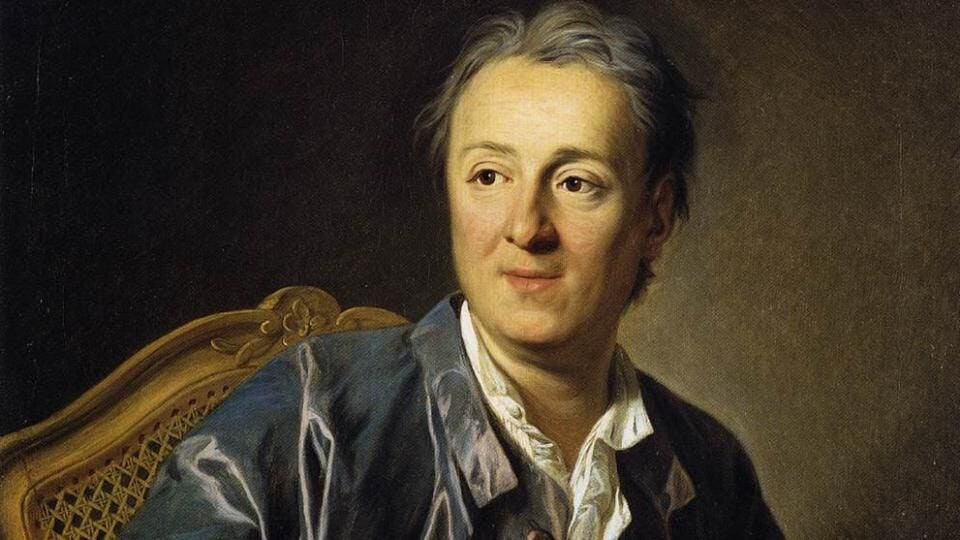
Denis Diderot (1713 – 1784)
Diderot was among the genuine exceptions to the rule that modern intellectuals often acted as validators who saw themselves as the collective owners of thoughtfulness, the custodians of knowledge in a world of mistaken illusions, prejudices and moral and political errors. As validators, they confirmed truths, expunged doubts, pointed out indisputable facts, authenticated what was already known, verified knowledge, sketched and substantiated new and better futures. The validators were wannabe influencers before their time. Their aim was to persuade publics of the rightness of their words, images and sounds and to support or reject rulers, or to improve their wisdom. The point should be obvious, but needs to be said: their critiques of thoughtlessness were strongly self-referential. These intellectuals took themselves to be the custodians and monopolists of firm, canonical and obligatory knowledge useful for the maintenance and perfection of the whole social and political order. They ranked themselves as masters and monopolists of thinking. Considered as validators, they came equipped with a strong sense of trust in their own resourcefulness, their ability to pronounce on the world. These intellectuals had no taste for the spirit of democracy. They were self-confirming and dutifully judgmental: men (nearly always) of thoughtful knowledge who considered themselves expert in the generation and delivery of superior knowledge to other people and institutions whose grasp on truth, ethical values and aesthetic judgement was reckoned inferior. Observe the circular quality of their borderline narcissism: by taking themselves as their own love-object, these intellectuals defined themselves by admiring themselves and perforce defining others as not like them, as different, as inferior because of their habitual thoughtlessness. Johann Gottlieb Fichte’s introduction to lectures he delivered to an excited audience at Jena in 1794 put things plainly. In an age in which ‘the majority are completely misled and dazzled’, he insisted, thinkers who display ‘sparks of higher genius’ and ‘take larger and more general views, and pass more accurate judgments on the phenomena presented to them’, must ‘without disturbance’ stay at arm’s length from thoughtless commoners who suppose that ‘everything which is printed should be made as practically useful as a cookery book, or a ready reckoner, or a service regulation, and decry everything which cannot so be used’. [12]
The self-referentialism within the ranks of the critics of unthinking behaviour – validators priding themselves on their clear-thinking ability to dismiss bias and prejudice – helps to explain their craving for tranquil isolation. Exactly because the world is contaminated by thoughtlessness, ran their reasoning, maintaining an arm’s length from the world, separating from the ranks of the thoughtless, is an absolute prerequisite of thinking, and thinking well. The presumption was that thinking requires cloistered leisure – distance from the clutter of life, freedom from the world, space in which the craving for independence enables intellectuals to confirm and pride themselves on their clear-headed grasp of the world, their ‘rationality’ in contrast to the ignorance or misguidedness of the masses who are burdened and preoccupied with the necessaries of life, and are therefore weighed down by the social complexity and social dysfunctions that succour their confusions, illusions, and thoughtless behaviour.
Within the European region, this yearning of thinkers to be freed from the clutches of the world of blind habits and foolish imaginings bears more than a passing resemblance to the monasticism born of the early Christian church during the last years of the 3rd century CE. Just as Jesus sojourned in the wilderness so the first Christian monks, following the example of St. Anthony, perhaps even inspired by earlier Buddhist and Jewish practices, sought perfection based on world-denying asceticism. They lived solitary lives as desert anchorites, cave and tomb dwellers, and as monks (from Greek monachos, single or solitary) inhabiting communes known as monasteries (monastirion, the cell of a hermit). Their piety was fuelled by the desire to turn away from the corrupted world, to see it with different eyes, to search for Christian perfection by living as saints and venerated martyrs whose search for the Truth of God stood at odds with the prevailing realities dominated by cravings of the body and devilish temptations of power and glory.
The yearning of modern thinkers to be rid of the chains of worldly corruption undoubtedly owes at least some inspiration to older beliefs in the saintliness of charismatic figures dedicated to the holy Christian life, but it also has pre-Christian roots as old as Western philosophy itself. Consider Plato, who famously defined thinking (to dianoeisthai) as a form of speech confined to the head, a soundless inner dialogue (eme emautō). He regarded thinking as a silent conversation inside our heads about some or other matter, a careful process of ‘asking questions of ourselves and answering them’ prior to making a silent mental judgment (doxa). For him, thinking happens when ‘the mind is alone and engaged with being’. Thinking is ‘speaking to oneself’ and ‘asking questions…and answering them, affirming and denying’.[13] Thinking is a solitary process in which the philosopher ruminates on the surrounding world, strives to call things by their right name, without distortion or inaccuracy. Thinking for Plato is the description of the world as it really is. It is the yearning for mimesis. Thinking aims to move closer to reality, to grasp what he calls the Forms or Ideas (eidos) of things in all their unchanging purity and quintessence. Thinking happens when a person thinks ‘something which is’. It is a solo performance dedicated to the difficult art of stripping away sights and sounds and other appearances and revealing how things actually are, without distortion, deletion or deception. Falsehood - claiming for instance that ‘an ox is a horse’ - is the enemy of thinking. Plato gets Socrates to summarise things plainly: no one is thinking when they make the mistake of confusing ‘one thing for another’ or blithely ignore what is ‘as it is’ (hōs esti).
Tasked with clarifying the nature of thinking and its links with democracy, this opening lecture isn’t the place to pass judgment on Plato’s thoughts on knowledge. The only important points to note are his anti-democratic conviction that thinking is an activity confined to philosophers - thinking is their bread and olives, butter, tarama and brandy - and his parallel claim that thinking is a thoroughly private activity, the silent search inside our heads for knowledge of the way things really are. We are shortly going to see that both precepts are untenable, yet striking is the fact that their grip on thinking about thinking has enjoyed a long life. It was Aristotle, Plato’s contemporary, who celebrated the life of the mind (bios theoretikos) as the life of a stranger (bios xenikos). During the Middle Ages in Europe, there was a common distinction between the active life of humans in the world and the solitary vita contemplativa of thinkers whose monkish vocation required them to withdraw from the world into the mysterious regions of the mind, which were thought of as superior domains. Well into modern times, it was said that thinking typically requires a measure of retreat from the world, and that sustained thinking needs preparation and readying ourselves to mull over matters. Consider the case of John Dewey, who retreated for twenty summers to the bays, lakes and harbours of Nova Scotia. Ludwig Wittgenstein meanwhile found solace in a Norwegian fjord hut Skjolden locals called ‘Austria’. ‘Thoughts at peace. That is the goal someone who philosophizes longs for’, he remarked. He spoke of ‘thinking as a process in the head, in a completely enclosed space’. ‘The philosopher’, he added, ‘is not a citizen of any community of ideas. That is what makes him into a philosopher’.[14] Heidegger was also fond of ‘die Hütte’, from where he complained about thoughtlessness in the form of an oft-repeated statement: ‘Most thought-provoking in our thought-provoking time is that we are still not thinking .’ And (to cite one more example) George Orwell carved out thinking time on a remote island of the Inner Hebrides. ‘Everyone keeps coming at me wanting me to lecture, to write commissioned booklets, to join this and that, etc,’, he told fellow writer Arthur Koestler in April 1946. ‘You don’t know how I pine to get free of it all and have time to think again.’[15] Life on the island of Jura offered him the possibility of thinking again – Nineteen Eighty-Four was the result - equipped only with a typewriter, a few gardening tools, a cow and a battery powered radio that kept him in contact with the outside world.

Thinking as a public matter
It’s worth thinking further about the claim that thinking is a process of intrapersonal seclusion. What’s noteworthy is the extent to which the originally Platonic notion of thinking as a form of quarantining of the self, sequestration, withdrawal from the world of others, silent questioning and answering, continues to ring true today, and does so for an understandable reason. Amidst the clutter and noise of everyday life, people regularly say they need time to think things over, that they can’t think straight with so many things going on around them, or that before going into a meeting, or appearing on some or other public stage, quiet time is needed to clear their heads and get their thinking straight.
This predilection for standing back seems self-evident. And yet think about it: consider for a moment the objection that in Plato’s dialogues the figure of Socrates relies upon interpersonal dialogue, bodily interaction with others by means of language, the medium through which thinking happens. The thought that language is the chrysalis within which the butterflies of thinking are hatched has become ever more prominent in modern writings on the subject. The trend presents a radical challenge to the myth that thinking is a task that can be done only in isolation. Among the first modern refusals of the myth was presented by the dramatist and storyteller Heinrich von Kleist. Challenging Enlightenment notions of reason, he pointed out that the fabrication of ideas in the workshop of the mind always depends on speech and writing, the art of thinking aloud in the company of others. Brooding alone is not equivalent to thinking. ‘If there is something you wish to know and by meditation you cannot find it,’ he tells a friend, offering written advice, ‘speak about it with the first acquaintance you encounter’. Conversations very often have head-clearing effects; rough and unfinished ideas blossom, confused ideas grow sharper. ‘Thought comes by speaking’, Kleist added, offering the example of Mirabeau, a formidable orator who served as a representative of the Third Estate at the historic meeting of the Estates General parliament in May 1789 – the final parliament of the ancien régime. After the King ordered the meeting to disperse, the Master of Ceremonies came to the hall where the defiant representatives were still gathered, asking them whether they had heard the ruler’s command. Mirabeau spontaneously stood up to deliver his ex tempore ‘thunderbolt’. ‘Yes, we have heard the King’s command’, he said defiantly, seizing the moment, grasping for his next thoughts. ‘Yes, my dear sir, we have heard it.’ He paused. ‘But by what right’, he asked, still searching for thoughts and words, ‘do you give us orders here?’ Then came the thunderclap. ‘We are the representatives of the nation’, he said. ‘The nation does not take orders. It gives them.’ For effect, another pause. ‘And to make myself perfectly plain to you…’. There followed the improvised explosion. ‘Tell your king we shall not move from here unless forced to by bayonets.’ Moments later, following the withdrawal of the Master of Ceremonies, Mirabeau proposed that the representatives form themselves into a National Assembly with inviolable rights. The Revolution had begun.[16]
Kleist was surely aware of the nuance that his account of speech and thinking drew upon the medium of writing. The decisive role played by writing as a form of communication in shaping acts of thinking later became a prominent, if heavily contested matter in scholarly writings on thinking. Prejudices certainly leaned hard against the view that writing is a means of thinking. Heidegger ranked Socrates as the purest thinker of the West because he wrote nothing, adding that ‘anyone who begins to write out of thoughtfulness must inevitably be like those people who run to seek refuge from any draught too strong for them.’ Compare Wittgenstein’s radically different testimony: ‘I really do think with my pen, for my head often knows nothing of what my hand is writing.[17] More needs to be said about writing and thinking because although we are in the habit of regarding language and thought as two different things, everyone who writes understands the challenge of grasping thoughts that wander or go missing unless they are written down. Wordless thoughts are often elusive; they easily escape us. When we write down our thoughts we come to understand that language is not just a means of transmitting to others pre-formed thoughts. Language and thinking are coincident: in the absence of words and writing, thoughts would be as nothing. Wordless thoughts are unknowable. As Wittgenstein noted, writing is a way of thinking, an experience of hanging on to and refining thoughts which would otherwise remain inchoate, or slip away. We could say that writing is thinking in motion; and that thought composes itself in writing. Thinking and writing are partners. The act of writing down thoughts enables our thinking to take stock of itself and to find its way in the world. With the help of writing, thinking can reconsider its content and form, table its own confusions, clarify its current pathways and push itself in different directions, often with surprising twists and turns, and unexpected consequences.
The communicative dimensions of thinking could be illustrated further by referring to media such as painting, photography, music and film, but here the important point is to note the obsolescence of traditional understandings of thought as a private, in-the-head matter. Thinking inescapably happens within symbol-structured language frameworks that are more or less shared with others in any given field of embodied social experience. A communicative turn requires us to see that thinking has public qualities. Just as six centuries after Copernicus we still talk (incorrectly) of sunrises and sunsets, so people continue to speak as if thinking is a lonesome experience. That’s in effect what we imply when we say we are ‘thinking out loud’. That expression portrays thinking as a wordless inner dialogue, as an act of talking to oneself in the imagination. But thinking is not a solo performance. Thinking is a bodily activity conjoined with others, not only (for instance) when we urge others to ‘think it over’ and they then get on with doing just that, but also in the sense that thinking takes place inside bodies and deep emotions that come steeped in language and entangled with others in fields of everyday life and wider social relations. Thinking is mucking with the world that provides us with food for thought. Ponder the case of women deep in conversation thinking through why they are angry about their maltreatement by men in their workplace. Their thinking is situated, embedded both in language and deep background bodily emotions, such as their feelings of self-respect and judgments that their own flourishing is vulnerable, and that they are being robbed of their well-being.[18] The case of anger at indignity shows that thinking is always publicly situated. It is not synonymous with the work of superior minds who linger in libraries and proclaim universal truths from ivory towers distant from everyday life. The vita contemplativa and the vita activa are conjoined twins. Thought comes actively entangled with symbolically-mediated institutions, events and power relations among people. It involves remembering what we did in the past, where we now belong, and where we might be headed. But there are limits to thinking back on things, immersing ourselves in times past. Thinking about the present and thinking forwards simultaneously requires us to put the past in its place. Here there’s a paradox. As Jorge Luis Borges long ago pointed out, thinking requires getting the measure of things by forgetting a potential infinity of details. If human beings were capable of remembering every single detail of everything that happens to them on a daily and nightly basis, they would drown in details. ‘To think is to forget differences’, he wrote. Thinking is the mental ability ‘to generalize, to make abstractions.’[19] This is also to say that thinking is earthbound, a practical way of picturing ourselves in relation to past and present others, strangers and adversaries and friends alike. Thinking is thus not understandable in terms of either the antiquated mind-body dualism or the problematic of the lonely self who lives at a distance from a community of others. When we think, whether or not we realise it, we indulge the democratic principle that our own lives are connected to and shared with others.
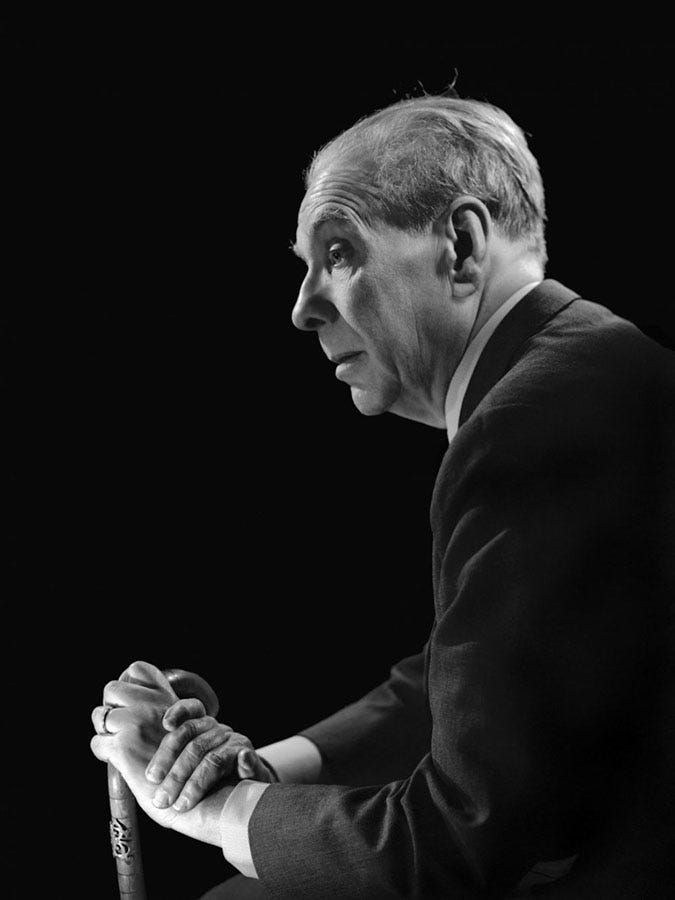
Jorge Luis Borges (1899 - 1986)
Come to think of it, thinking has democratic qualities in another sense: it comes in plural forms whose diversity cannot be overcome by insisting upon one single way of thinking or one universal standard or model of thought. ‘The mind relies on [general] principles constantly’, remarked the Leipzig-born leading 17th-century rationalist Gottfried Wilhelm Leibniz, ‘but it does not find it so easy to sort them out and to command a distinct view of each of them separately, for that requires great attention to what it is doing, and the unreflective majority are hardly capable of that.’[20] Among the most thoughtfully illuminating and influential critiques of this monistic way of thinking about thinking was Ludwig Wittgenstein’s insistence that language-mediated frameworks of embodied interaction with others are the medium of thinking in its various forms.[21] He periodically craved being alone, but as we are now going to see Wittgenstein’s pluralist understanding of thinking doubted that ‘reason’ is something that happens silently and is located invisibly inside our heads, uncontaminated and unconstrained by the world around us, as thinkers following Plato usually supposed. Consider Descartes, who was sure that it takes ‘very little reason to be able to speak’ because humans, in contrast to ‘beasts’ and ‘machines’, are endowed with a ‘rational soul’ that enables even the stupidest person to learn a language. In evolutionary and normative terms, reason trumps language. First comes ‘reason’. Then language.[22]
Wittgenstein objected. When we think, we not only ‘take hold’ [Zugreifen] of the world around us. The world simultaneously takes hold of our thinking. Thinking isn’t a silent inner dialogue; thinking is communicative engagement with others by means of concepts labelled with names that are learned and interpretable within the existing rules of any given language game. Practically speaking, this means that if someone acting within a language framework says something like ‘After thinking about it, I’m sure that 12 times 12 equals 144’, those unfamiliar with mathematics would probably deem those words and their thinking as uninteresting or as trivial nonsense. Speakers of Chinese or Arabic might not even understand the statement, except through translation, while others, striking workers on a picket line for instance, would almost certainly heckle and jeer those uttering the thought in sentence form (as Bertolt Brecht observed). Wittgenstein’s point was that the thinking that takes place within any given language game is structured by its rule-bound modus operandi. Thinking has no universal qualities. Context dependence is its fate. The content and style of thinking typically differs from one language game to another; and whenever, for whatever reason, a language game undergoes change, thinking itself changes.
Let’s think more about Wittgenstein’s point about the public quality of thinking. Within any given language game, he tells us, thinking takes its cues from ‘pictures of the world [Weltbilder]’. These world views are not innate; Kant misled us into thinking that framing categories are innate, perhaps God-given. World views are learned in and through participation in language games. They serve as maps that guide the pathways of our thought. They imbue our thinking with a sense of certainty guided by ‘sure evidence’ whose acceptance enables us to act ‘without any doubt’. These linguistically shaped cognitive pictures exempt things from doubt. They provide a more or less taken-for-granted frame of reference, a set of firm guidelines for what counts as ‘correctness’, as up and down, right and wrong, true and false. Switching similes, Wittgenstein likens these habitually unchallenged, more or less taken-for-granted pictures of the world as the riverbeds through which our streams of thinking take place when interacting with others. The key point for him is that ‘certainty resides in the nature of the language game’ and that thinking that claims to produce knowledge ‘is in the end based on acknowledgement’ by others.
This way of thinking about thinking takes us another step closer towards our subject of democracy. Most immediately, it has profound implications for the practice of philosophy, which hereon, said Wittgenstein, cannot ignore its own role as one type of language game among others. Thoughtlessness or sloppy thinking, he wanted to say, happens when ‘language goes on holiday’. The new task of a more modest, language-games-sensitive philosophy is therefore to counsel humility and sensitivity to differences, to remind philosophers and their audiences that philosophical thinking is only one mode of thinking. Philosophers can be compared to little children, he daringly suggested. Grownups draw pictures for children saying ‘this is a house’ or ‘this is a man’. Children follow suit. They similarly do their own drawings, asking adults ‘what’s this?’ Philosophers do the same. After scribbling things on pieces of paper, they ask ‘what’s this?’ and ‘what does it mean?’[23] If philosophy is a form of symbolically-mediated interaction with the world, then the implication is that it is only a refined form of what all people regularly do in everyday life: they construct pictures of the world, make statements, ask questions and strive to make sense of their lives. For Wittgenstein, philosophy nevertheless remains functionally important. It is a form of therapy, a process of patiently ‘assembling reminders’ of how thinking functions within language games, and of the difficulty or outright impossibility of assimilating the terms of one language game to another language game. The role of philosophy, above all, is to encourage people to come to terms with the loss of certainty, to help them realise that there are no all-embracing criteria for assessing things and people in the world, to which we could appeal, with absolute certainty, with ‘complete conviction, the total absence of doubt’. In other words, our thinking must hereon acknowledge that thinking cannot exonerate us from incertitude and that the great challenge to be faced by people is to get used to the thought that thinking cannot rescue us from ‘the groundlessness of our believing’. Imagine a world, he says, in which it was ‘forbidden to say “I know” and only allowed to say “I believe I know”.’
Worth thinking about more thoroughly is a hidden but democratically significant implication of this remark about the vulnerable, insecure and alterable language-mediated foundations of our everyday living. We could make the inference that it isn’t just professional philosophers and other validators who are forbidden to say they ‘know’ things with absolute certainty - and that aspiring validators must perforce abandon their traditional yearning to use their ‘knowledge’ of the world to take it by the scruff of its neck in order better to conquer and control it. There’s a flipside point: the propensity to think is much more widespread than philosophers have long supposed. Wittgenstein doesn’t say this so plainly, but here the point is that everybody, all humans, are implicated in his own insistence that thinking happens within contingent and alterable language-mediated frameworks of embodied interaction with others. Put even more plainly: thinking is not only imbued with public qualities. Every human being is capable of feeling the need periodically to use their brains to turn things over in their minds. It’s true that ‘mind’ is a tricky category. It’s also true we all take time out from thinking; blank minds are not the burden of thoughtless idiots and fools alone. Professional thoughtlessness in university settings happens. And although some people are more gifted or practised at the learned art of thinking than others, it’s also the case that everybody resorts to thinking, often many times each day. Thinking is not the exclusive privilege of (say) policy wonks, scholars, public intellectuals, political thinkers, writers, moralists, theologians and mystics. It is not the property of ‘civilised’ peoples. There are no ‘naturally’ licensed monopolists of thinking. If that’s so then those people who try to act as if they are professional validators of superior knowledge aren’t entitled automatically to claim that they are an expert minority entitled to deliver truth, ethical values and aesthetic judgements to a majority of inferior, unthinking others.
If the capacity for thinking among human beings is much more universally distributed than past critics of ‘thoughtlessness’ supposed then it’s easy to see that their doubts and denunciations projected at whole categories of people deemed ‘ignorant’ or ‘thoughtless’ become indefensible. The corollary of this point has additional democratic ramifications, for if people are generally endowed with the ability to think then they’re both entitled to think for themselves and duty-bound to respect the propensity of others to think in unfettered ways. The implication is that nobody, certainly not the rich and the powerful, never mind arrogant bosses and bullies, is authorised to stand in the way of people thinking about things in the presence of others. The radical democratic implications of this point are far-reaching. Insofar as all people dwelling on our planet are blessed with the capacity to think, it should come as unsurprising that thinking varies not just in content but comes in highly diverse forms. Thinking has ambient qualities. It happens in all cultures, past and present, and its variability is striking. Let’s return to Wittgenstein’s wise counsel. ‘What men and women consider reasonable or unreasonable alters’, he wrote. ‘At certain periods they find reasonable what at other periods they found unreasonable. And vice versa.’. The search for universal ‘reason’ is a fool’s errand. Even efforts to confirm what counts as ‘reasonable’ by getting reason to take its cue from empirical ‘evidence’ are fraught and doomed to fail, because references to ‘facts’ and ‘data’ are always incorrigibly shaped by context-bound and time/space variable language games and their world pictures. Again, Wittgenstein: ‘The truth’ of certain empirical propositions belongs to our frame of reference’, and that is why, he added, pushing the point to its daring conclusion, ‘it is important to imagine a language in which our concept “knowledge” does not exist’.[24]
Modes of Embodied Thinking
There’s a sting in the tail of Wittgenstein’s remark: all people are endowed with the potential to think, to think often, and to think well, in their different ways. Previous accounts of thinking typically ignore these differences. They indulge the bad habit of supposing there’s just one way of thinking, and that access to its singular arts is reserved for the privileged few. Consider the lectures on thinking delivered by Heidegger just before his retirement from the University of Freiburg. ‘Man is the rational animal’ but the human capacity for thought is destroyed by modern technologies of control, he said. Thoughtlessness spreads, to the point where ‘the most thought-provoking thing about our thought-provoking age is that we are still not thinking.’ Note that the identity of the collective ‘we’ is unspecified. Observe as well Heidegger’s insistence that the remedy for thoughtlessness was a new form of meditative thinking that engages and heeds the call of Being. He supposed that there was only one genuine mode of thinking whose demanding requirements considerably exceed the capacities of most people. Heidegger tells us that ‘human beings can think in the sense that “they possess the possibility of doing so”’, but most people, busily indulging ‘empty talk’ and ‘talking platitudes’ in a ‘technological age’swamped in ‘remote-controlled public opinion’, aren’t able to think. Thinking is overrun by ‘blinking’ (blinken; blenchen), ‘glittering deceptions which come to be agreed upon as true and valid’). The upshot is that ‘the involvement with thought is in itself a rare thing, reserved for few people’, he noted. Hence his conclusion: ‘Philosophers are the thinkers par excellence.’[25]
Note the contradiction: said to be coterminous with being human, thinking is portrayed as a special form of high-brow mental activity reserved only for the few. Recognition of the variability of thinking is anathema to this way of thinking about thinking, despite the elementary fact that many different modes of thinking are readily observable among individuals and groups alike. Research by psychologists and educators on what they call ‘multiple intelligences’ has highlighted the way individuals’ inherited and learned capacity to think is not singular but differentiated. There are people who have a way with words. They learn the art of intelligent oratory or easily understand and speak other languages or master the arts of thoughtful reading. They are gifted linguists. Other people display an unusually thoughtful feel for the biomes in which they dwell. Ecological intelligence is their thing. They skilfully recognise different flora and fauna, and intuitively understand the complexity and fragility of living and non-living environments. They think of themselves as deeply attached to their planetary surrounds, and express indignation and voice intelligent criticisms of the destruction of lands, forests, waters. Some individuals display a special knack of thinking abstractly and competently handling numbers and formal logic. There are dancers, athletes, builders, actors and other people whose kinaesthetic acuity is unusually sharp. Their bodily grace, self-disciplined agility and learned sense of timing and perfection are remarkable. Not to be overlooked are those musically talented individuals endowed with a quickness of mind, a sharp grasp of tempo and tone, the ability to spot and re-create absolute pitch, an intelligence for sound, rhythm, structure and audience reception.[26]
These differing modes of thoughtfulness have roots in early childhood when, well before the moment a child utters their first words, ‘reality’ and bodily motion begins to be mentally organised in terms of space-time and perceived causal structures.[27] Recent research further complicates matters by speaking of gut intelligence to refer to the highly complex ways in which the countless millimetre-sized messenger circuits and sensors of human intestines function as a ‘second brain’ of our bodies. Immunologists remind us that human cognition is entangled with highly complex, very much individualised immune systems comprising receptor cells charged with dealing with foodstuffs and bacterial toxins and phagocytes patrolling freely throughout the body on the lookout for aging or damaged cells.[28] The old mind-versus-body problem that preoccupied so many past philosophers is invalidated by these new lines of research: the body isn’t a simple, homogeneous entity, and thinking isn’t confined to human heads operating at a distance from the rest of the body. Researchers also report that intelligence isn’t exclusive to humans. Primatologists complain that we humans are gripped by unthinking anthropodenialism; we are convinced, falsely, that we’re animals of a special type, ‘rational’ creatures unconnected with either our biology or our biosphere. Counter-developments in bioacoustic methods confirm that animal intelligence, the capacity for communicative interaction, emotional learning, cunning deception and prudent conflict resolution, is widespread, and central to the lives of species such as elephants, bees, porpoises, whales, squirrels, bats and birds who talk in their own strange ways to each other.[29] Orthodox pictures of thinking are further complicated by the realisation that among humans, modes of thinking are group dependent. As the following randomly chosen examples of modes of human cognition illustrate, there are astonishing differences from one group to another in different space-time settings.
Yīn-yáng
Consider the yīn-yáng doctrine central to the correlative thinking of the proto-sciences of medicine, astronomy, divination in early China.[30] This doctrine is not a comprehensive cosmology that teaches its believers how correctly to act in the world. Yīn-yáng thinking shuns the preoccupation with analysing causes and practical utility and avoids dubious jumps from ‘is’ to ‘ought’. Contrary to today’s simplistic and commercialised Western usages of the phrase yīn-yáng, the doctrine is rather a modest vocabulary for thoughtfully clarifying the relationships among things and making good sense of the world in ways freed from black-and-white, either-or thinking. First formulated systematically by scholars just before and during the Han dynasty (206 BCE – 220 CE), this way of seeing the world highlights the entanglement and co-dependence of phenomena. Yīn-yáng thinking is syntagmatic: it is preoccupied with clarifying the orderly, structural relationship among the interacting constituent units of a meaningful whole. Matters such as birth and death, summer and winter, the human body and the body politic, heaven and earth are regarded as correlative and assimilated and differentiated in chains of interdependence. The 10th-century BCE Book of Poetry speaks of yīn as rain and yáng as the sun that evaporates the morning dew; yīn and yáng also denote the shaded and sunlit sides of a mountain. Later texts regularly reasoned in terms of correlations. The book Mo-tzu, named after master Mozi (c. 479 – 381 BCE), the first outspoken critic of Confucius, noted that ‘the heat and cold made by Heaven are in proportion, the four seasons are in tune, sunshine, shade, rain and dew are timely’ (chapter 8 -37). Others thought along similar correlative lines, for instance observing that since fish dive down and startled birds fly up, and since water goes down in contrast to fire which goes up, and since as well fish contrast with birds just as water contrasts with fire, fish like water will go down and birds like fire will go up. Note how the yīn and yáng pairs of correspondences are not binary opposites. Each is without a fixed form. They are defined in terms of each other. They wax and wane together, which implies not only that each has no fixed essence but also that change in one element redefines the form and substance of the other element. In matters of thought, the yīn-yáng relationship is thus dynamic, charged with energy and constantly changing.
Religious thinking
There’s a commonplace story that around 1600 scientific thinking in the European region gradually swapped causal thinking for correlative approaches. It is said that the search for mathematized laws of nature and testing hypotheses using controlled experiments pushed correlative reasoning into the background. The adventure is said to have resulted in the birth of modern science which in turn signalled the beginning of the end of religious metaphysics. Despite the best efforts of figures such as Kepler, whose formulation of three laws of planetary motion supposed that the sun, stars and planets of our cosmos were correlated with the persons of the Trinity, religion gradually withered away. Thought underwent a secularisation; or, as Max Weber claimed, there followed a ‘disenchantment of the world’.
Whatever the merits of this story of the triumph of modernisation and the corresponding disappearance of the holy, a countertrend - a global renaissance of multiple religions – must be noted. This rejuvenation of religiosity adds to the sense of variability and incommensurability of modes of human thought.
But what is religious thinking? What does it mean to think religiously? Put simply, central to the lived experience of the divine are personal and collective feelings of the ‘numinous’.[31] In the monotheistic religions of Judaism, Christianity and Islam, belief in the divine is anchored in subjectively lived certainties about the existence of an objectively existing God. The belief in divinity is a form of thinking; it is a mistake to suppose that religious belief is copulation with the clouds, emotional ecstasy, mental stupor, dumb amazement, or mindless indulgence of ‘irrationality’. In practice, thoughtful meditation – ‘reason’ and ‘rationality’ – are intrinsic to the religious experience; the belief in the divine is only possible because believers frame their convictions using concepts that can be understood, defined and pondered by the intellect. But thoughtful rationality in this sense is bounded. Within religious experience, exhaustive ‘rational’ summaries of the quintessence of God are prohibited. Believers cannot rely exclusively on ‘rational’ interpretations of the divine. Their experience of the divine is supra-rational.
A peculiar feature of religious consciousness is the admixture of conceptual thinking and the inexpressible, or the ineffable. The encounter with God cannot fully be described or expressed in thought or words. Within the religious experience, there is a never-fully nameable and not-fully-definable and knowable Being who both lies beyond and dwells within each and every believer. God is beyond reason. A God graspable by reason is no God at all. This deeply felt ‘numinous’ state of mind is intrinsic to the experience of the holy. The numinous is the feeling of utter dependence upon an elusive higher Being whose cosmic supremacy induces a sense of nothingness within the believer. Objectivity trumps subjectivity. The numinous is more than a conscious ‘feeling of objective presence’ or the perception of ‘something there’.[32] Strictly speaking, religious awareness is the conscious experience of a mystery that is at once fascinating, intoxicating and terrifying. The grip of the mysterious and the awe-inspiring (mysterium tremendum) arouses within the believer an ebb-and-flow mixture of thoughtful feelings. They range from calm wonder and fearless courage, blissful joy and shuddering dread. They include as well the ‘hushed, trembling, and speechless humility of the creature in the presence of…a mystery inexpressible and above all creatures’.[33] Gripped by the holy, intoxicated with the esoteric, the unfamiliar and the extraordinary, thought bows down before the daemonic unknown. Thinking is humbled by a power that towers over the world.[34] This submission is self-consciously felt and lived but it isn’t fully graspable by conceptual reasoning. Here there’s a final twist in the encounter of the passionately thinking believer with the divine: far from being reduced to ‘ashes and dust’ nothingness, the Believer feels empowered. Luminosity is the twin of numinosity. The daunting encounter with the absolutely supreme divine inspires moral perfection and beliefs in the possible granting of eternal life. Religious experience has a Dionysian quality. Trembling in awe, believers are blessed by the bliss of grace, conversion, rebirth and salvation. Cowed and cast down, they become the transcendent, or what Germans call the überweltlich. Human selfishness is dissolved in the rapture of a divine purity granted by an omniscient, omnipotent, wrathful and loving God – or so the monotheist mode of thinking supposes.
Indigenous thinking
In our times, it is - or should be - self-evident that religion is only one among many different modes of thinking. Whether religioners view things that way is another matter; as we are going to see throughout these lectures, the incommensurability and possible antagonisms among different modes of lived thinking is a central political concern of democratic politics. For the moment, the elementary point under consideration is that religion, along with correlation, are only two of many different ways of thinking about our world. More challenging is the question of whether and how to interpret the modes of thinking of indigenous peoples.
Early ethnography and 19th-century anthropology typically regarded the question as superfluous. An early missionary ethnologist, who in his encounters with indigenous peoples in the colony of South Australia described himself as driven by ‘a desire to try to do something for their spiritual and temporal welfare’, was convinced that ‘the Gospel of Christ will be the means of saving a remnant from extinction’. He reported that indigenous peoples, ‘blackfellows’, were ‘daring and restless people’ skilled at causing ‘trouble to the authorities by their depredations and sheep stealing.’ A ‘barbarous people’ known for their ‘fierceness and savagery’, they were ‘dreadfully afraid of seeing ghosts’ and ‘careless of the natural causes of disease’. These fierce, fearful and foul ‘heathen’ people commit infanticide and other ‘terrible crimes’ while some are ‘drunkards and gamblers’ who ‘have neither religion nor morality, and are utterly lawless’. Their celebrations include songs of the ‘vilest obscenity’ and ‘immodest and lewd’ dancing by women. Weighed down by ‘superstition’ and ‘many ridiculous traditions’, these peoples even embrace ‘legends’ about animals ‘which they regard as a sort of good genius’.[35]
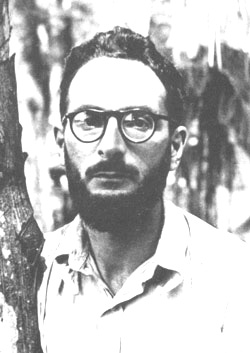
Claude Lévi-Strauss (1908 - 2009)
Amateur European anthropology of this type in effect concluded that indigenous peoples are genetically incapable of thinking abstractly. More recent anthropology – adventurous works such as Evans-Pritchard’s study of the Zande society in southern Sudan, and Claude Lévi-Strauss’s account of la pensée sauvage - have torn apart the presumption, pride and prejudice of this amateurism. These authors point out in various ways that indigenous societies aren’t governed by jumbled thinking, mumbo-jumbo oracles and magical practices and general primitive irrationality.[36] The ‘savage mind’ is sophisticated. Within indigenous societies, thinking happens in elaborate ways, but the thinking is of a radically different, strangely unfamiliar type. Seen from this revised standpoint – indigenous peoples as thinkers whose lived mental classifications of the world are wondrous, stringent and precise – the challenge is not only to erase the primitivism within Eurocentric thinking about ‘primitive’ societies whose members are regarded as uncivilised, as less-than-human, as creatures whose observable behaviour purportedly confirms that primus homo non est rationalis. The challenge is also to reject the prejudice that these societies are merely ‘traditional’ political orders which nurture their members’ collective memories and horizons of expectation by means of taught knowledge of the imperative of intergenerational solidarity. The challenging point is that indigenous societies cultivate sophisticated thinking about their own entanglement with trees, plants, animals, hills, mountains, valleys, rivers, lakes and oceans, the sky and the heavens. Classification systems – carefully described, catalogued and analysed names given to the whole world - are the key to understanding why their members are not dopes but smart thinkers who have a taste for erudition and who are constantly reasoning and making sense of their lives, both as individuals and in association with others.
As expected, much research shows that the content of indigenous thinking is highly variable. The terms of thoughtful classification of the world are a function of the history and culture of the group and of the rules of the language games in which they operate. This means, as Wittgenstein taught, that words and ranked categories don’t have an intrinsic significance; their meaning is manifested through rule-bound usages within the given framework of classification. Inside these lived classificatory systems, there is plenty of room for ‘biting ridicule’ and joking, even the obligation to tease or make fun of others who are required to take no offence.[37] Striking, too, is indigenous peoples’ markedly disparate interpretations of life. For some groups, for instance, the sun is a woman who went foraging for food to the edge of the earth then returned to be with her child next day; others categorise the sun as a benevolent father; still others as a flesh-eating cannibal.[38] There are clear disagreements about the origins of the universe, too. According to Osage legends, the ancestors of the Great Plains people emerged from the bowels of the earth and split into two groups: a peace-loving, herbivore group associated with the left side and a bellicose, carnivorous group associated with the right. The two groups later formed an alliance and chose to exchange their respective foods. By contrast, the Bād people of Australia’s Western Kimberley region believe that the world was made by a revered supreme being named Djamar. An unmarried man who lives alone except for his dog, he dwells simultaneously under the rocks of nearby ocean coastlines, in creek beds and silent water pools, and high up in the heavens. From that location, their sky dweller is thought to watch over his people, make his presence felt during initiation ceremonies and generally guarantee that his laws are obeyed.[39]
Within and among the conjoined descent groups known as moieties, thoughtful living similarly displays a sophisticated complexity. There’s a never-ending fascination with plants and animals and their habitats plus an inexhaustible thirst for objective knowledge of the entire world. This quest for knowledge is not primarily geared to the satisfaction of food and other ‘material’ needs. Plants, insects and animals are not observed, given names and meaningfully categorised because they are deemed useful. Intelligibility trumps utility. And the thoughtful categorisations are not a ‘mythical’ diversion or distraction from an underlying ‘reality’. Indigenous peoples don’t think in that ‘mythical’ way. In drawing up rigorous taxonomies they do the thinking done by later geologists, zoologists, botanists and astronomers; and they do so without indulging the later Cartesian dualism between the res cogitans and a non-human res extensa. For these peoples, everything in the universe is a lived object of wonder, reflection and classification. More than that, the world is thought to comprise animals, trees, plants and other living entities who are themselves teachers endowed with intelligence. Ancestors learned these ways of thinking. They bequeathed this knowledge to future generations. In honour of the past and the future, the present generation is thus required thoughtfully to observe, catalogue, respect, worship, revere and fear this world of beings. The obligation to think is not tied to a single goal; and it is not a form of purposive rationality geared, say, to securing a collective sense of belonging and order based on shared memories. Indigenous thinking is restless. It is adventurous. In search of meaning in the face of the unexpected, it ‘never tires of ordering and re-ordering’. Thinking ‘acts as a liberator by its protest against the idea that anything can be meaningless’.[40] Thoughtfulness is thus valued as an end-in-itself. It bestows aesthetic fulfilment; promotes the intelligibility of all things large and small in the universe; and searches for the protection and spiritual well-being of generations past, present and future.
Thinking as Adventure
The different forms of thinking discussed above are obviously not mutually exclusive. There are overlaps – yīn-yáng thinking and indigenous modes of thinking emphasise in their respective ways the entanglement and relationality of subjects and objects within our universe, for instance - but there are also significant differences and disagreements concerning such matters as the existence or non-existence of an all-powerful, awe-inspiring God. In the absence of what could be called a Final Resolution, these similarities and discrepancies reinforce the case for thinking democratically about thinking. The points are clear. It is not just philosophers who are capable of thinking. Everyone can think. This universal capacity for thinking implies another democratic imperative: every human is both entitled freely to think for themselves and obliged to respect the capacity of other people to think. Nobody is entitled to block people thinking in the company of others. It is the job of thinking people, wrote Albert Camus, ‘to decide whether they will add to the misery of the world’ or instead work ‘to give future generations - who will be even better armed than ourselves - a chance for survival.’[41] The equal right to think is fundamental. And there is a further important implication for how to think about democracy and thinking: since all people are endowed with the ability to think, democracy is a way of life and a mode of self-government which acknowledges that there are many different modes of thinking whose space-time variability must be protected in conformity with the rule that all people are entitled to think, and to think without hindrance or abuse. The torture, brutalisation and murder of people who think, or who think differently from others, is a crime.
These lectures openly address the unavoidably political matter of how the storm and stress of public clashes among different modes of thought are best handled fairly, and without violence, bossing and backsliding towards despotic rule. But, for the moment, the remaining issue to be thought about concerns what counts as thinking. The German sociologist Max Weber famously distinguished between two different forms of thinking. Calculative thought (Zweckrationalität) is a mode of rationality preoccupied with the technical means for achieving a pre-defined, given goal. Weber worried about the expansionism of this ‘formal’ or ‘bureaucratic’ rationality. Colonising all spheres of modern life, the spirit of calculation ruthlessly and irresistibly transforms everything into an object of administrative control. Ethical considerations, thinking preoccupied with or guided by a particular set of norms, or what Weber called substantive-value rationality (Wertrationalität), degenerates. Individuals become mere cogs in the machine, insects in iron cages, victims of calculative thinking.[42] While we’ve seen already that critics of modern thoughtlessness have often used this important distinction to emphasise the pathologies generated by the tightening monopoly grip of technical rationality upon the whole of life - think of Heidegger’s complaints about the spreading polyphony of ethical viewpoints and the fetish of technical reason – the downside of Weber’s treatment of two different modes of thinking must be noted. It failed to consider the most interesting and most fundamental question: what exactly do we mean by thinking?
Neuroscientists provide an answer, but although they offer descriptions of how thinking happens, their accounts are of limited utility when tackling the question. They tell us that thoughts are generated by bursts of electrical impulses connecting different nerve fibre endings. Their reports on how our brains function owe much to the early 20th-century research of neuroanatomists such as Santiago Ramón y Cajal, who rejected the reigning orthodoxy of vitalism, the dogma that thinking is an effect of soul-like immaterial energy, and who also contradicted the standard picture of the human brain as a single structure comprising a conglomeration of connected cells.[43] The neurosciences are today divided by controversies and more than a few puzzling unknowns, for instance concerning why the billions of electrified nerve fibres - neurons comprising dendrites, soma, axons and axon terminals - of healthy living brains undergo neurogenesis, and why our heads are able to orchestrate ‘brain symphonies’, non-linear, highly unpredictable ‘emergent properties’ such as human consciousness.[44]
The question still remains: what is thinking? Plausible replies initially require refusal of the essentialism lurking within the question. Thinking is true to itself when it refuses to be pinned down. Thinking requires an open mind. An open mind is always in at least two minds. We could say that thinking requires the willingness of individuals and groups to practise thinking, to learn the arts of thinking, a commitment to the adventure of thinking. Thinking is for this reason not to be equated with expressing an opinion, or having a view about something. ‘I think it’s going to be sunny today’ and ‘I think I will take the day off’ are not instances of thinking, but examples of a forecast and a statement of intent. Thinking is not holding a viewpoint, stating a preference, confirming a prejudice, making an offer, or expressing a taste for something. Thinking is also not to be mistaken for assertions of the correctness of a statement or an action. Pointing out which day of the week it is, or telling the time, or confirming a lunch appointment all require brains and mental work, but they don’t count as examples of thinking. Contrary to believers in rock-bottom ‘reality’, or the ‘logical priority of brute facts over institutional facts’,[45] thinking is not the process of tabling or searching for ideas whose correctness or ‘truth’ is measured by their correspondence with some external object or state of affairs. The search for adequation - the art of establishing an identity, correspondence between, words and objects, thoughts and the real world – is the enemy of thinking.
Thinking indeed requires bursts of electrical impulses inside our brains but compared with so-called statements of fact, opinion or taste, thinking is always a process in the grip of uncertainty. When people think about any matter in any given space-time context, they are engaged in a search. Reaching a conclusion may be the terminus of thinking, but in a strict sense thinking is always an unfinished process, an unending journey, not a conclusion or destination. There is a ‘staircase’ quality of thinking, as Denis Diderot famously noted after attending a dinner at the home of statesman Jacques Necker. Confounded by a guest’s argument levelled against him, Diderot fell into confusion. Only later, downstairs from the dining room and on his way home, struggling with what native French speakers call l’esprit d’escalier, he managed afterwards to deal with his confusion by thinking things through calmly and clearly.[46] Infused with the spirit of afterthoughts, thinking is perforce not ratiocination, if by that term is meant fastidiously precise, methodically rigorous and ‘logical’ reasoning that proceeds from the known to the unknown by obeying given rules, for instance when making a deduction from a founding premise, or when reasoning inductively for the purpose of reaching a conclusion from prior premises and observations. Thinking isn’t ‘logic’. And it isn’t calculated or manufactured polemic and prejudice. It’s much wilder than that.[47] It has ‘abductive’ qualities. It is unruly and insubordinate, a ‘lawless’ or ‘rule breaking’ process of discovery.[48] Thinking is tabling questions ignored by previous answers. It is challenging and unlearning old ways of thinking; along the way, it risks confusion and unsettlement, the food of thought.
Here our thinking about thinking brings us to a final surprise connection between democracy and thinking. For just as the spirit and substance of democracy are not figurable, so thinking is always an unpredictable and undefinable process. When people speak of ‘strategic thinking’ and ‘tactical thinking’ they risk indulging oxymorons; in a strict sense, strategy and tactics are types of calculation whose formulation, at least for a time, draws upon the quite different process of what we call thinking things over. One-track minds don’t think. ChatGPT can’t think. When asked what it means to think, and why thinking is important, this is one version of its reply:
‘Thinking refers to the cognitive process of forming ideas, concepts, and mental representations of the world around us. It involves analyzing information, making connections, and synthesizing new ideas based on what we know and what we observe. Thinking is crucial for problem-solving, decision-making, planning, and creativity. It allows us to understand complex issues and make sense of our experiences. By engaging in critical thinking, we can evaluate information and arguments, identify biases and assumptions, and make informed decisions. Moreover, thinking is essential for personal growth and development. By reflecting on our experiences, beliefs, and values, we can gain self-awareness, develop new perspectives, and enhance our understanding of the world. In summary, thinking is an essential process that allows us to navigate the world, make decisions, and grow as individuals.’
This isn’t thinking. It is the sham musings of a so-called artificially intelligent, pre-programmed robot which hasn’t understood that thinking is marked by pointlessness. When thinking, we often get lost in our thoughts because we are in unfamiliar territory. Thinking offers no salvation. Pot boiler books and how-to-think manuals promising to reveal to readers what they ‘really think’ and ‘what it all adds up to’ are counterfeits.[49] When we think we don’t set ourselves the task of figuring out how to explain, master and control the world about us. Wittgenstein said it well: ‘Ambition is the death of thought.’ [50] There’s a definite impracticality about thinking. Lives are altered by thinking things over, but thinking isn’t making plans or loud mouthing opinions and polemics. Thinkers aren’t pipers who play tunes for the unthinking. And thinking does not put those who think on the path to heaven, or hell. Thinking can come on doves’ feet, as Nietzsche said.[51] It can yield moments of joy has an indefinite, restless, fugitive quality. It can breed frustration, melancholia, anger; or; or leave a thinker drowning for a time in confusion, as when ideas buzz about in our heads. Like weather, thinking can find itself trapped in doldrums, or enjoy gentle breezes at its back, or find itself in darkening depression, blown hither and thither by fierce winds. Infused with various feelings, thinking is marked by a definite shapelessness. It’s never completed and never fully satisfied with its own progress and conclusions, or the conclusions of others. Thinking, as Heidegger said, is always underway (inter vias).[52] Done well, thinking generates surprises. In contrast to calculations structured by cock-sure conclusions, or Weber’s purposive rationality, thinking is the abandonment of certainty, a process of yielding to puzzlement and the incomprehensible. Believing is easier than thinking because when we think, we place ourselves at the mercy of our thoughts. As thinking gets underway, our thoughts breed yet more thoughts, sometimes to the point where it’s hard to say whether we have thoughts or the thoughts have us. Thinking takes us on a journey into a world where things seem out of synch. Things feel unfamiliar and somehow odd. Dogmas and certainties are thrown into question. Gas bags are spiked. Thinking confronts us with the unknown and takes us on an adventure – in the same way, hopefully, the following lectures make the familiar seem strange by stirring up the sense that in these turbulent times thinking about democracy is imperative, an urgent requirement of its survival and rejuvenation.
[1] Gustave Le Bon, ‘The Immediate Factors of the Opinions of Crowds’, The Crowd: A study of the popular mind (Dunwoody, Georgia, 1968 [1895]), book 2, chapter 2 p. 105.
[2] H. L. Mencken, Notes on Democracy (London 1927), pp. 164 – 165, 28, 31.
[3] Anthony M. Ludovici, The False Assumptions of “Democracy” (London 1921), p. 132.
[4] Jason Brennan, Against Democracy (Princeton, NJ., 2017).
[5] Examples of these criticisms include Gary Marcus and Ernest Davis, Rebooting AI: Building Artificial Intelligence We Can Trust (New York 2019); Ronald Deibert, Reset: Reclaiming the Internet for Civil Society (The CBC Massey Lectures, Toronto 2020); John Keane, “Twelve More Bytes: Reflections on Jeanette Winterson’, available at Democracy and Its Enemies: https://johnkeane.substack.com/
[6] Elon Musk et. al., ‘Pause Giant AI Experiments: An Open Letter’, at https://futureoflife.org/open-letter/pause-giant-ai-experiments/. The signatories pose two dramatic questions: ‘Should we develop nonhuman minds that might eventually outnumber, outsmart, obsolete and replace us? Should we risk loss of control of our civilization?’
[7] Martin Heidegger, Discourse on Thinking (New York 1966), p. 45
[8] Hannah Arendt, The Life of the Mind (New York and London, 1978), pp. 3 -16; compare Eichmann in Jerusalem (New York 1964), p. 49, where emphasis is laid on Eichmann’s ‘inability to think,…to think from the standpoint of somebody else. No communication was possible with him, not because he lied but because he was surrounded by the most reliable of all safeguards against the words and the presence of others, and hence against reality as such.’
[9] The key text is the essay ‘The Present Age’ (1846), in Søren Kierkegaard, The Present Age and Two Minor Ethico-Religious Treatises (Oxford 1940), pp. 3-70.
[10] The following quotations are drawn from Adam Smith, An Inquiry into the Nature and Causes of The Wealth of Nations (Chicago 1976 [1776]), Book 5, chapter 1.
[11] Zygmunt Bauman, Legislators and Interpreters: On Modernity, Post-Modernity and Intellectuals (Cambridge 1991), pp. 4-5.
[12] Johann Gottlieb Fichte, The Vocation of the Scholar (London 1847), pp. 18-19.
[13] Theaetetus, in The Dialogues of Plato, translated by Benjamin Jowett (New York 1897), volume 3, pp. 390 – 395, sections 187-190. The claim that thinking is ‘unuttered conversation of the soul with herself’ in which ‘affirmation or denial takes place silently and in the mind only’ is repeated by the Eleatic Stranger in Sophist 263e–264a, in ibid. pp. 504 – 505.
[14] Wittgenstein, Culture and Value (Oxford 1998), p. 50e; Zettel 606; 455.
[15] ‘Letter to Arthur Koestler [13 April 1946]’, in The Collected Essays, Journalism and Letters of George Orwell, edited Sonia Orwell and Ian Angus (London 1968), volume 4, p. 146.
[16] Heinrich von Kleist, ‘On the Gradual Production of Thoughts Whilst Speaking’ (Über die allmähliche Verfertigung der Gedanken beim Reden) [c. 1805 – 1806], in Selected Writings, edited David Constantine (London 1997), pp. 405 – 409.
[17] Martin Heidegger, What Is Called Thinking? (New York, San Francisco and London, 1967), p. 17; Ludwig Wittgenstein, Vermischte Bemerkungen: Eine Auswahl aus dem Nachlass/Culture and Value: A Selection from the Posthumous Remains (oxford 1998), 24e
[18] Martha C. Nussbaum, Upheavals of Thought: The Intelligence of Emotions (Cambridge and New York, 2001). More generally on the generative roles of bodies in struggles for democracy see Amanda Machin, Bodies of Democracy: Modes of Embodied Politics (New York 2022).
[19] Jorge Luis Borges, ‘Funes, The Memorious’, in Ficciones (New York 1962), p. 115 (my translation).
[20] Gottfried Wilhelm Leibniz, New Essays on Human Understanding (Cambridge and New York, 1996), section 84.
[21] The following quotations are drawn from Ludwig Wittgenstein, Über Gewissheit/On Certainty (New York 1972), 510, 61, 65, 256, 196, 94, 162, 97, 457, 378, 166, 366.
[22] René Descartes, ‘Discourse on the Method’, in The Philosophical Writings of Descartes (Cambridge 1984), volume 2, pp. 140 -141
[23] Ludwig Wittgenstein, Culture and Value, op. cit., 24e
[24] Ludwig Wittgenstein, Über Gewissheit/On Certainty, op. cit., 336, 83, 562.
[25] Martin Heidegger, What Is Called Thinking? pp. 3, 6-7, 49, 72, 74 (my translation), 126, 4-5.
[26] Howard Gardner, Frames of Mind: The Theory of Multiple Intelligences (New York 1983); Intelligence Reframed: Multiple Intelligences for the 21st Century (New York 2000); ‘Reflections on Multiple Intelligences: Myths and Messages’, Phi Delta Kappan: Journal for the promotion of leadership in education, volume 77, 3 (November 1995), pp. 200 –209.
[27] Jean Piaget, The Origins of Intelligence in Children (New York 1951) and Jean Piaget and Bärbel Inhelder, The Psychology of the Child (London 1969).
[28] Susanne Billig und Petra Geist, ‘Der Darm als „zweites Gehirn“ des Menschen’, Deutschlandfunk Kultur (June 4, 2015), at: https://www.deutschlandfunkkultur.de/medizin-der-darm-als-zweites-gehirn-des-menschen-100.html; Anne Marie Moulin, ‘The Immune System: A Key Concept for the History of Immunology,’ History and Philosophy of the Life Sciences, volume 11, no. 2 (1989), pp. 221-236.
[29] Samples of the recent research include Karen Bakker, The Sounds of Life: How Digital Technology Is Bringing Us Closer to the Worlds of Animals and Plants (Princeton 2022); Janet Mann (ed.), Deep Thinkers: Inside the Minds of Whales, Dolphins, and Porpoises (Chicago 2017); Frans de Waal, Mama’s Last Hug: Animal Emotions and What They Tell Us About Ourselves (New York 2020); and Denise L. Herzing and Christine M. Johnson (eds.), Dolphin Communication and Cognition: Past, Present, and Future (Cambridge, Mass., 2015).
[30] She King (Book of Poetry), in The Chinese Classics, translated by James Legge, volume 4, second edition (Taipei 1935), pp. 55, 276, 488; see also Marcel Granet’s La pensée chinoise (Paris 1950 [1934]) and Angus C. Graham, Yin-Yang and the Nature of Correlative Thinking (Singapore 1986).
[31] Rudolf Otto, The Idea of the Holy: An inquiry into the non-rational factor in the idea of the divine and its relation to the rational (London 1923); and Religious Essays, A Supplement to the Idea of the Holy (Oxford 1931).
[32] William James, The Varieties of Religious Experience: A Study in Human Nature (London 1928), p. 58.
[33] Rudolf Otto, The Idea of the Holy: An inquiry into the non-rational factor in the idea of the divine and its relation to the rational, p. 13.
[34] R.R. Marett, ‘The Birth of Humility’, in The Threshold of Religion 2nd edition 1914, pp. check
[35] George Taplin, The Narrinyeri: An Account of the South Australian Aborigines (Adelaide 1874), pp. iii-iv, 5-7, 15, 23, 27-29, 48.
[36] E.E. Evans-Pritchard, Witchcraft, Oracles, and Magic Among the Azande (Oxford 1937); Claude Lévi-Strauss, The Savage Mind (Chicago and London, 1966).
[37] T.G.H. Strehlow, Aranda Traditions (Melbourne 1947), pp. 82-83; A. R. Radcliffe-Brown, ‘On Joking Relationships’, in Structure and Function in Primitive Society (London and Henley 1952), pp. 90 – 116; Pierre Clastres, ‘What Makes Indians Laugh’, in Society Against the State (Oxford 1977), pp. 108 – 127.
[38] A. W. Howitt, Native Tribes of South-East Australia (London 1904), pp. 427 – 428.
[39] E.A. Worms, ‘Initiationsfeiern’, Annali Lateranensi, 2 (1938), pp. 179 – 180; and ‘Djamar, the Creator’, Anthropos XLV (1950), pp. 643 – 658; Claude Lévi-Strauss, The Savage Mind, op. cit. p. 69.
[40] Claude Lévi-Strauss, The Savage Mind, op. cit., p. 22; see also Marshall Sahlins, ‘Rationalities: How “Natives Think”’, in How ‘Natives’ Think, About Captain Cook, For Example (Chicago and London 1995), pp. 148 – 189.
[41] Albert Camus, Between Hell and Reason: Essays from the Resistance Newspaper Combat, 1944 - 1947 (Hanover NH, and London, 1991), p. 138.
[42] John Keane, ‘The Legacy of Max Weber’, in Public Life and Late Capitalism (Cambridge and New York 1984), pp. 30 -69.
[43] Benjamin Ehrlich, The Brain in Search of Itself: Santiago Ramón y Cajal and the Story of the Neuron (New York 2022).
[44] Michel Thiebaut de Schotten and Stephanie J. Forkel, ‘The emergent properties of the connected brain’, Science, volume 378, 6619 (3 November 2022), pp. 505–510.
[45] John Searle, The Construction of Social Reality (New York 1997), pp. 55-56.
[46] Denis Diderot, Paradoxe sur le comédien [1773-1777] (Paris 2000).
[47] See my ‘Wild Thinking’, in Power and Humility: The Future of Monitory Democracy, op. cit., pp. 133 -179.
[48] Charles Sanders Peirce, Collected Papers of Charles Sanders Peirce, edited by C. Hartshorne, P. Weiss, and A. Burks (Cambridge MA, 1935), volume 5, pp. 172, 590.
[49] Julian Baggini and Jeremy Stangroom, Do You Think What You Think You Think?: The Ultimate Philosophical Handbook (New York 2007).
[50] Ludwig Wittgenstein, Culture and Value: A Selection from the Posthumous Remains (Oxford 1998), p. 88e.
[51] Friedrich Nietzsche, ‘The Stillest Hour’, in Thus Spoke Zarathustra, part 2
[52] Martin Heidegger, What Is Called Thinking? 12-13, 28, 31